


Every new fleet customer used to trigger a new integration project. Different charger brands, CPMS vendors, and site configurations meant setups had to be rebuilt each time, turning every deployment into custom engineering instead of a repeatable product.
With ChargeBroker, eight separate CPMS connections were consolidated into a single vendor-neutral gateway, allowing any new fleet to be onboarded through the same integration, regardless of hardware, backend, or depot setup.
CharliEV adds centralized remote management across the entire portfolio, giving both the integrator and fleet operators a unified operational view in one consistent environment.
The integrator stopped writing custom code. They started scaling.
Use Cases
Infrastructure Integration
Fleet Electrification
Products
Features
Vendor-Neutral Integration Layer
Mix & Match Tech
Remote Management
Centralized Overview
About the Company
Jibe developes eBusiness solutions that can deliver scalable solutions with proven security for a faster time to market.
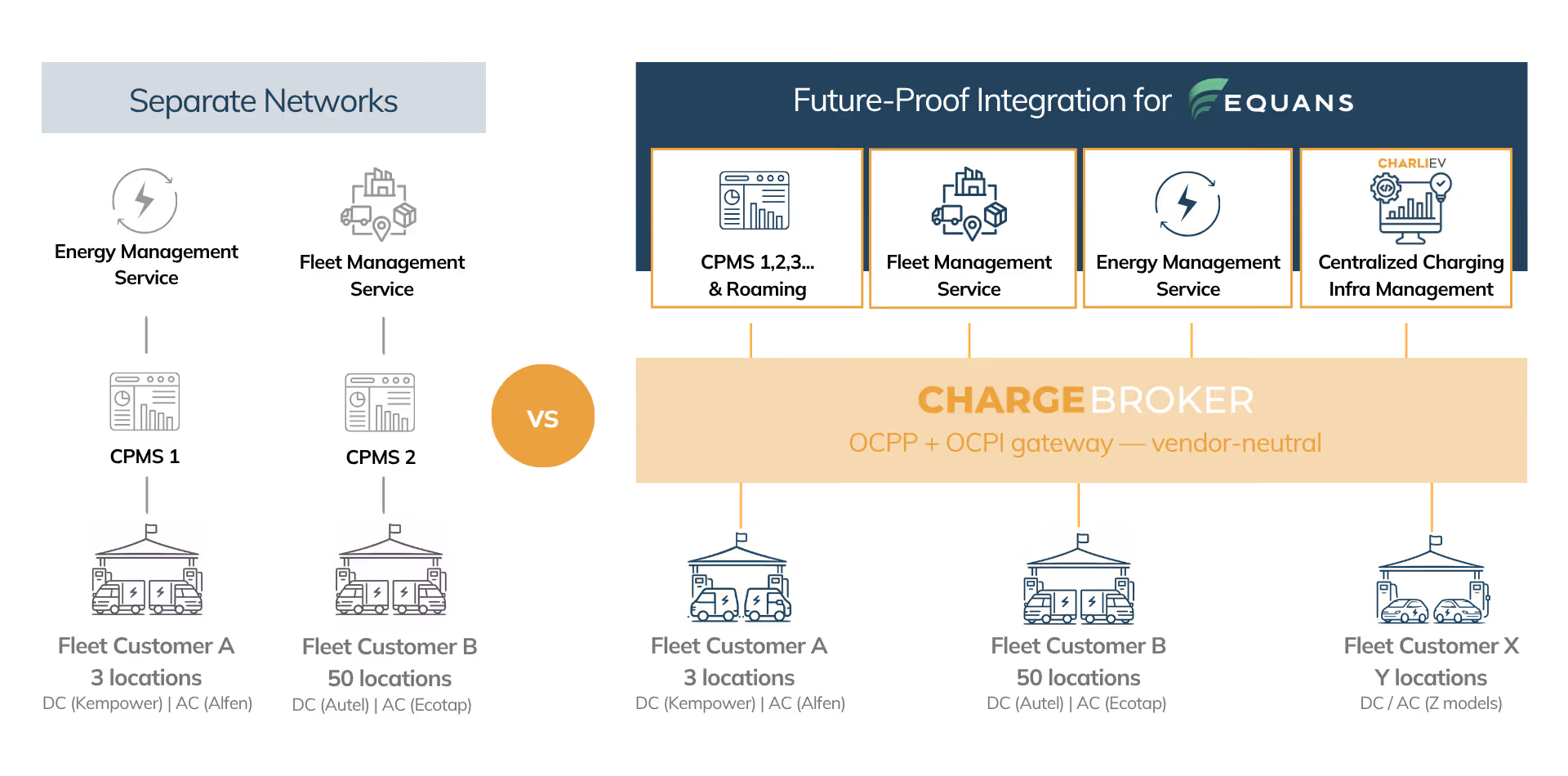
Find out moreFor system integrators managing fleet electrification, the multi-vendor reality turns every deployment into a custom build — and every change request into rework across the stack.
Every DC charger brand ships its own management portal. Technical teams must learn, maintain, and track version changes for each — Kempower, Alfen, Autel, ABB — multiplying training and operational overhead.
Without a vendor-neutral integration layer, each fleet customer means a bespoke project. Different charger hardware, different CPMS platforms, different site configurations — no two deployments are alike.
The fleet operator had started electrifying location by location — resulting in up to 8 different CPMSs across 15 depots. Session data, token management, and ERE credit reporting each required separate systems.
The fleet operator — a major European food distribution company — had already begun electrifying independently across 15 depot locations. Each location had its own charger hardware, its own CPMS, and its own workflows. Before ChargeBroker, consolidating charge detail records for ERE emission credit reporting meant logging into 8 separate systems — each with different export formats.
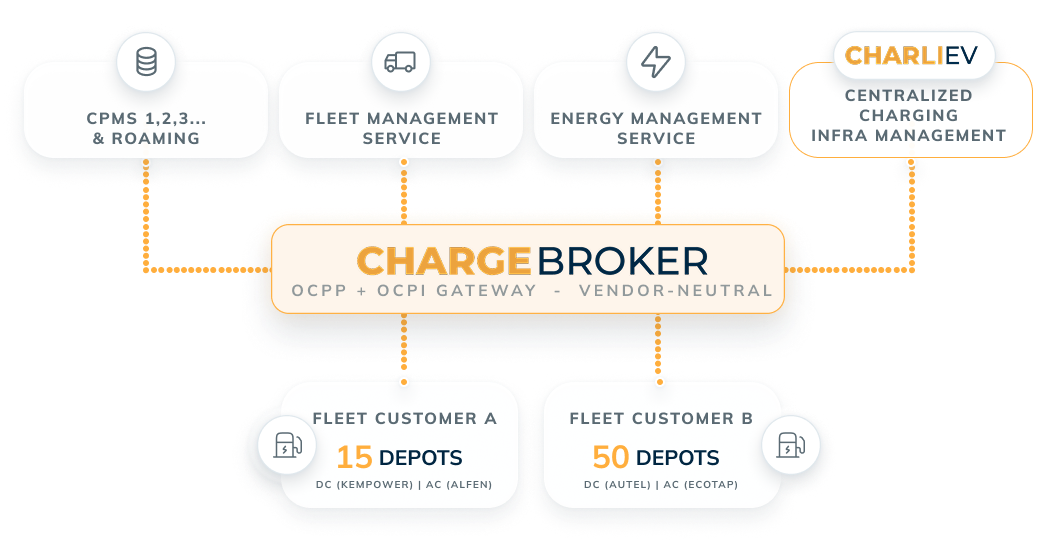
ChargeBroker connects to any charger brand at any location, while CharliEV provides centralized management — for both the system integrator and their fleet customers.
1. Connect
Deploy ChargeBroker as the OCPP + OCPI gateway across all customer locations. Connects to any charger brand — Kempower, Alfen, Autel, Alpitronic, Keba, and more.
2. Standardize
The integrator uses CharliEV to manage all chargers from one application — configuration templates, alerts, and incident management feed into their existing workflow systems.
3. Serve
Fleet operators get their own CharliEV view: centralized token management, live charging dashboards, unified session data, and ERE-ready reporting — across all depots.
4. Scale
Add new customers, new locations, or new charger brands without re-architecting. Per-customer software services can be mixed and matched from the ChargeBroker marketplace.
ChargeBroker sits between chargers and software partners as a vendor-neutral orchestration layer — enabling system integrators to serve any customer with any hardware-software combination.
ChargeBroker was configured in under an hour. From pilot to live fleet operations — real results from the first deployment.
ChargeBroker was configured in under an hour. From pilot to live fleet operations — real results from the first deployment. Gateway configured and connected on day one — not a concern after that.
From 8 separate systems to one unified view for session data and reporting.
New customer locations connect through existing infrastructure — no rebuild required
*Transparency note: Onboarding speed is based on observed deployment performance. Setup time and CPMS consolidation figures reflect the pilot deployment. Quantified cost savings will be published as the deployment matures.
All charge detail records centralized for ERE emission credit revenue processing.
Kempower, Alfen, Autel, Alpitronic, Keba — any brand, any CPMS, any location.
Real-time charging speed, progress, and state-of-charge visibility per depot.
What makes this bundle powerful is the double win. System integrators standardize how charging infrastructure is integrated and operated, while their customers gain a fleet charging platform from the same provider. The integrator stays vendor-agnostic, and fleet operators get a unified view of their charging infrastructure without adding more vendors or operational finger-pointing.
The ChargeBroker + CharliEV bundle delivers distinct value to both the system integrator and their fleet customers — through the same platform.
The bundle grows with both the integrator and their fleet customers — each on their own trajectory from first deployment to full optimization.